

Report on Kilauea (United States) — 27 August-2 September 2025
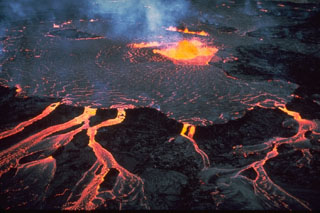
Smithsonian Institution / US Geological Survey
Weekly Volcanic Activity Report, 27 August-2 September 2025
Managing Editor: Sally Sennert.
Please cite this report as:
Global Volcanism Program, 2025. Report on Kilauea (United States) (Sennert, S, ed.). Weekly Volcanic Activity Report, 27 August-2 September 2025. Smithsonian Institution and US Geological Survey.
Kilauea
United States
19.421°N, 155.287°W; summit elev. 1222 m
All times are local (unless otherwise noted)
The Hawaiian Volcano Observatory (HVO) reported that the eruption within Kilauea’s Kaluapele summit caldera, characterized by episodic fountaining, incandescence, and intermittent spatter at vents with craters along the SW margin of Halema’uma’u Crater, continued at variable levels during 27 August-2 September. Minor incandescence at the N vent was intermittently visible during 27-30 August but intensified overnight during 30-31 August, indicating that lava was nearing the surface. Spattering at the N vent began at around 2000 on 31 August and by the early morning on 1 September the surface of the lava pond within the vent had risen to the point of being almost visible in a webcam view.
At around 2030 on 1 September gas-pistoning cycles began, with lava continuing to fill the N crater. Brief overflows of lava down the crater flanks were visible at 0043 and 0045 on 2 September. Several more vigorous and cyclic overflows occured at 0258, 0312, 0233, 0358, 0411, and 0425; each cycle lasted 6-17 minutes and was followed by minor drain-backs of 1-2 m. At 0521 the overflows became continuous and low dome fountains were visible. The dome fountains intensified at 0635; lava fountains soon grew to 100 m high and were inclined 45 degrees NW. By 0711 the fountains were 150 m high and arcing about 150 m across. At around 0820 the fountains turned slightly counterclockwise to the NNE. Sulfur dioxide emission rates were estimated to be at least 50,000 tonnes/day, a typical rate during periods of fountaining. Fountaining was continuous for 13.4 hours from the N vent, and during this time both the S and middle vents were also active. The N vent ceased erupting at 1949 and the S and middle vents ceased erupting at 2001, after a few minutes of lava jetting. Lava output averaged more than 200 cubic meters per second and produced over 9.6 million cubic meters of lava, the highest output so far during this eruption for one of these short fountaining episodes. Lava flows covered 40-50 percent of the caldera floor. The Volcano Alert Level remained at Watch (the third level on a four-level scale) and the Aviation Color Code remained at Orange (the third color on a four-color scale).
Geological Summary. Kilauea overlaps the E flank of the massive Mauna Loa shield volcano in the island of Hawaii. Eruptions are prominent in Polynesian legends; written documentation since 1820 records frequent summit and flank lava flow eruptions interspersed with periods of long-term lava lake activity at Halemaumau crater in the summit caldera until 1924. The 3 x 5 km caldera was formed in several stages about 1,500 years ago and during the 18th century; eruptions have also originated from the lengthy East and Southwest rift zones, which extend to the ocean in both directions. About 90% of the surface of the basaltic shield volcano is formed of lava flows less than about 1,100 years old; 70% of the surface is younger than 600 years. The long-term eruption from the East rift zone between 1983 and 2018 produced lava flows covering more than 100 km2, destroyed hundreds of houses, and added new coastline.
Source: US Geological Survey Hawaiian Volcano Observatory (HVO)
