

Report on Poas (Costa Rica) — 27 August-2 September 2025
Smithsonian Institution / US Geological Survey
Weekly Volcanic Activity Report, 27 August-2 September 2025
Managing Editor: Sally Sennert.
Please cite this report as:
Global Volcanism Program, 2025. Report on Poas (Costa Rica) (Sennert, S, ed.). Weekly Volcanic Activity Report, 27 August-2 September 2025. Smithsonian Institution and US Geological Survey.
Poas
Costa Rica
10.2°N, 84.233°W; summit elev. 2697 m
All times are local (unless otherwise noted)
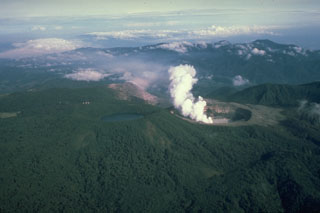
The Observatorio Vulcanológico y Sismológico de Costa Rica-Universidad Nacional (OVSICORI-UNA) reported continuing gas-and-steam emissions with occasional minor amounts of ash at Poás during 27 August-2 September. Variable incandescence at Boca A vent continued to be visible at night. At 1230 on 2 September a gray steam-and-gas plume with a moderate amount of ash rose 500 m above the crater rim and drifted W. A few hours later, at 1703, a light-gray steam-and-gas plume with minor ash content rose 300 m above the crater rim. The Volcanic Alert Level remained at 2 (the second lowest level on a four-level scale).
Geological Summary. The broad vegetated edifice of Poás, one of the most active volcanoes of Costa Rica, contains three craters along a N-S line. The frequently visited multi-hued summit crater lakes of the basaltic-to-dacitic volcano are easily accessible by vehicle from the nearby capital city of San José. A N-S-trending fissure cutting the complex stratovolcano extends to the lower N flank, where it has produced the Congo stratovolcano and several lake-filled maars. The southernmost of the two summit crater lakes, Botos, last erupted about 7,500 years ago. The more prominent geothermally heated northern lake, Laguna Caliente, is one of the world's most acidic natural lakes, with a pH of near zero. It has been the site of frequent phreatic and phreatomagmatic eruptions since an eruption was reported in 1828. Eruptions often include geyser-like ejections of crater-lake water.
Source: Observatorio Vulcanologico y Sismologico de Costa Rica-Universidad Nacional (OVSICORI-UNA)
