

Report on Kilauea (United States) — 17 September-23 September 2025
Smithsonian Institution / US Geological Survey
Weekly Volcanic Activity Report, 17 September-23 September 2025
Managing Editor: Sally Sennert.
Please cite this report as:
Global Volcanism Program, 2025. Report on Kilauea (United States) (Sennert, S, ed.). Weekly Volcanic Activity Report, 17 September-23 September 2025. Smithsonian Institution and US Geological Survey.
Kilauea
United States
19.421°N, 155.287°W; summit elev. 1222 m
All times are local (unless otherwise noted)
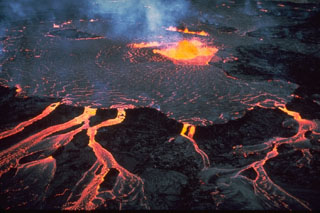
The Hawaiian Volcano Observatory (HVO) reported that the eruption within Kilauea’s Kaluapele summit caldera, characterized by episodic fountaining, incandescence, and intermittent spatter from craters along the SW margin of Halema’uma’u Crater, continued at variable levels during 16-23 September. Incandescence at both the N and S vents was visible overnight during 16-17 September. Gas pistoning (a shallow, gas-driven rise and fall of a lava surface) at the N vent was followed by brief overflows of lava beginning at 0838 on 17 September. Overflows became larger during 17-18 September and dome fountains that were 3-6 m high accompanied the filling and overflowing of the vent. Drainbacks of lava were marked by energetic bursts of gas that sent spatter 5-10 m high and landed on the outside of the cone. Continuous low lava fountains began at approximately 0244 on 19 September and intensified until 0311, when fountains rose up to 150 m and large lava flows began advancing onto the crater floor. An eruption plume rose 3 km above the ground surface and drifted SW. Fountains initially rose as high as 240 m but by 0921 they were just over 100 m high and inclined about 60 degrees towards the E. The S vent began erupting at unspecified time then stopped at around 0600. After nine hours of continuous fountaining at the N vent, the eruption abruptly ended at 1208. Approximately 6.3 million cubic meters of lava had erupted, and lava flows covered about two thirds of the Halema’uma’u Crater floor. Minor incandescence was recorded daily at the S vent, and during most days at the N vent, during 20-23 September. Gas plumes continued to be emitted from the vents.
Geological Summary. Kilauea overlaps the E flank of the massive Mauna Loa shield volcano in the island of Hawaii. Eruptions are prominent in Polynesian legends; written documentation since 1820 records frequent summit and flank lava flow eruptions interspersed with periods of long-term lava lake activity at Halemaumau crater in the summit caldera until 1924. The 3 x 5 km caldera was formed in several stages about 1,500 years ago and during the 18th century; eruptions have also originated from the lengthy East and Southwest rift zones, which extend to the ocean in both directions. About 90% of the surface of the basaltic shield volcano is formed of lava flows less than about 1,100 years old; 70% of the surface is younger than 600 years. The long-term eruption from the East rift zone between 1983 and 2018 produced lava flows covering more than 100 km2, destroyed hundreds of houses, and added new coastline.
Source: US Geological Survey Hawaiian Volcano Observatory (HVO)
