

Report on Kanlaon (Philippines) — 3 September-9 September 2025
Smithsonian Institution / US Geological Survey
Weekly Volcanic Activity Report, 3 September-9 September 2025
Managing Editor: Sally Sennert.
Please cite this report as:
Global Volcanism Program, 2025. Report on Kanlaon (Philippines) (Sennert, S, ed.). Weekly Volcanic Activity Report, 3 September-9 September 2025. Smithsonian Institution and US Geological Survey.
Kanlaon
Philippines
10.4096°N, 123.13°E; summit elev. 2422 m
All times are local (unless otherwise noted)
The Philippine Institute of Volcanology and Seismology (PHIVOLCS) reported continuing unrest and an ash emission at Kanlaon during 2-10 September. The seismic network recorded 0-7 daily volcanic earthquakes and daily sulfur dioxide emissions ranged from 762 to 1,922 tonnes per day. Gas-and-steam emissions of variable densities rose 75-700 m above the crater rim and drifted N, NW, and WSW. A period of diffuse ash emissions began at 1725 on 8 September and lasted about 55 minutes, producing low ash plumes that drifted WSW. At 0510 on 10 September an ash plume rose 600 m above the crater rim. The Alert Level remained at 2 (on a scale of 0-5); the public was warned to stay out of the 4-km-radius Permanent Danger Zone (PDZ) and pilots were advised to avoid flying close to the summit.
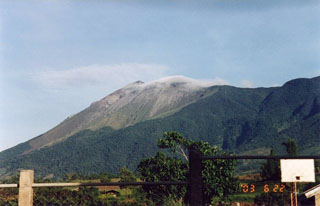
Geological Summary. Kanlaon volcano (also spelled Canlaon) forms the highest point on the Philippine island of Negros. The massive andesitic stratovolcano is covered with fissure-controlled pyroclastic cones and craters, many of which are filled by lakes. The largest debris avalanche known in the Philippines traveled 33 km SW from Kanlaon. The summit contains a 2-km-wide, elongated northern caldera with a crater lake and a smaller but higher active vent, Lugud crater, to the south. Eruptions recorded since 1866 have typically consisted of phreatic explosions of small-to-moderate size that produce minor local ashfall.
Source: Philippine Institute of Volcanology and Seismology (PHIVOLCS)
