

Report on Kirishimayama (Japan) — 3 September-9 September 2025
Smithsonian Institution / US Geological Survey
Weekly Volcanic Activity Report, 3 September-9 September 2025
Managing Editor: Sally Sennert.
Please cite this report as:
Global Volcanism Program, 2025. Report on Kirishimayama (Japan) (Sennert, S, ed.). Weekly Volcanic Activity Report, 3 September-9 September 2025. Smithsonian Institution and US Geological Survey.
Kirishimayama
Japan
31.934°N, 130.862°E; summit elev. 1700 m
All times are local (unless otherwise noted)
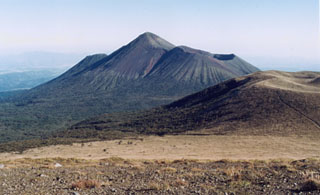
The Japan Meteorological Agency (JMA) reported that activity continued at Shinmoedake (Shinmoe peak, a stratovolcano of the Kirishimayama volcano group) during 3-9 September. The number of volcanic earthquakes located beneath Shinmoedake, first detected in late October 2024, continued to be frequent; volcanic tremor was detected during 2-3 September. Eruptive events at 1127 and 1300 and a period of continuous ash emissions during 1330-1342 on 3 September produced ash plumes that rose as high as 2.3 km above the crater rim and drifted SW. Ash plumes from eruptive events at 1432 and 1556 later that day rose as high as 1.1 km above the crater rim and drifted SW. Ashfall reported in areas downwind, including in Kirishima City (21 km SW) and Miyakonojo City (30 km SE), obscured the lines on some roads. Continuous ash emissions during 0854-1000 on 5 September rose 100-200 m above the crater rim and drifted SE. At 0344 on 7 September an ash plume rose 100 m above the crater rim and drifted E. Continuous ash emissions during 2033-2231 on 7 September rose 100 m above the crater rim and drifted E. Fumarolic plumes rose as high as 10 m above the fissures on the W flank during 5-8 September. The Alert Level remained at 3 (on a 5-level scale) and the public was warned to exercise caution within 3 km from Shinmoedake Crater.
Geological Summary. Kirishimayama is a large group of more than 20 Quaternary volcanoes located north of Kagoshima Bay. The late-Pleistocene to Holocene dominantly andesitic group consists of stratovolcanoes, pyroclastic cones, maars, and underlying shield volcanoes located over an area of 20 x 30 km. The larger stratovolcanoes are scattered throughout the field, with the centrally located Karakunidake being the highest. Onamiike and Miike, the two largest maars, are located SW of Karakunidake and at its far eastern end, respectively. Holocene eruptions have been concentrated along an E-W line of vents from Miike to Ohachi, and at Shinmoedake to the NE. Frequent small-to-moderate explosive eruptions have been recorded since the 8th century.
