

Report on Sabancaya (Peru) — 10 September-16 September 2025
Smithsonian Institution / US Geological Survey
Weekly Volcanic Activity Report, 10 September-16 September 2025
Managing Editor: Sally Sennert.
Please cite this report as:
Global Volcanism Program, 2025. Report on Sabancaya (Peru) (Sennert, S, ed.). Weekly Volcanic Activity Report, 10 September-16 September 2025. Smithsonian Institution and US Geological Survey.
Sabancaya
Peru
15.787°S, 71.857°W; summit elev. 5960 m
All times are local (unless otherwise noted)
The Instituto Geofísico del Perú’s (IGP) Centro Vulcanológico Nacional (CENVUL) reported that at 1625 on 13 September an explosion at Sabancaya generated an ash plume that rose 5 km above the crater rim and drifted at least 20 km W, S, and SE. Pyroclastic flows descended the NW, N, and NE flanks as far as 1.6 km. Sulfur dioxide emissions were at low levels, averaging 218 tons per day, and no thermal anomalies were identified. The Alert Level was raised to Orange (the second highest level on a four-color scale) on 13 September and the public was warned to stay outside of a 12 km radius from the summit.
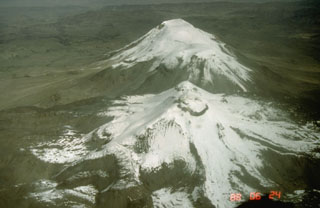
Geological Summary. Sabancaya, located in the saddle NE of Ampato and SE of Hualca Hualca volcanoes, is the youngest of these volcanic centers and the only one to have erupted in historical time. The oldest of the three, Nevado Hualca Hualca, is of probable late-Pliocene to early Pleistocene age. The name Sabancaya (meaning "tongue of fire" in the Quechua language) first appeared in records in 1595 CE, suggesting activity prior to that date. Holocene activity has consisted of Plinian eruptions followed by emission of voluminous andesitic and dacitic lava flows, which form an extensive apron around the volcano on all sides but the south. Records of observed eruptions date back to 1750 CE.
