

Report on Bezymianny (Russia) — 12 November-18 November 2025
Smithsonian Institution / US Geological Survey
Weekly Volcanic Activity Report, 12 November-18 November 2025
Managing Editor: Sally Sennert.
Please cite this report as:
Global Volcanism Program, 2025. Report on Bezymianny (Russia) (Sennert, S, ed.). Weekly Volcanic Activity Report, 12 November-18 November 2025. Smithsonian Institution and US Geological Survey.
Bezymianny
Russia
55.972°N, 160.595°E; summit elev. 2882 m
All times are local (unless otherwise noted)
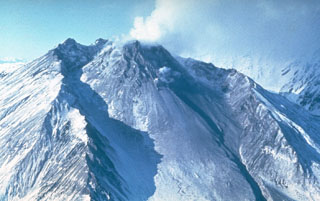
The Kamchatkan Volcanic Eruption Response Team (KVERT) raised the Aviation Color Code at Bezymianny to Orange (the second highest level on a four-color scale) at 0351 on 10 November due to increasing activity. During the previous few days a large and hot thermal anomaly was identified in satellite images, and intense gas-and-steam emissions along with hot avalanches were visible. The Far Eastern Branch of the Russian Academy of Sciences (FEB RAS) reported that hot avalanches of material descended the SE flank on most days during 7-16 November; weather clouds sometimes obscured views. Steam, gas, and ash plumes rose 1.2 km above the summit and drifted SW on 13 November. Dates are reported in UTC; specific events are in local time where noted.
Geological Summary. The modern Bezymianny, much smaller than its massive neighbors Kamen and Kliuchevskoi on the Kamchatka Peninsula, was formed about 4,700 years ago over a late-Pleistocene lava-dome complex and an edifice built about 11,000-7,000 years ago. Three periods of intensified activity have occurred during the past 3,000 years. The latest period, which was preceded by a 1,000-year quiescence, began with the dramatic 1955-56 eruption. This eruption, similar to that of St. Helens in 1980, produced a large open crater that was formed by collapse of the summit and an associated lateral blast. Subsequent episodic but ongoing lava-dome growth, accompanied by intermittent explosive activity and pyroclastic flows, has largely filled the 1956 crater.
Sources: Kamchatkan Volcanic Eruption Response Team (KVERT), Institute of Volcanology and Seismology (IVS) of the Far Eastern Branch of the Russian Academy of Sciences (FEB RAS)
