

Report on Karangetang (Indonesia) — 13 August-19 August 2025
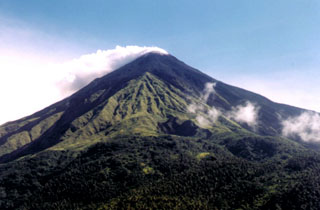
Smithsonian Institution / US Geological Survey
Weekly Volcanic Activity Report, 13 August-19 August 2025
Managing Editor: Sally Sennert.
Please cite this report as:
Global Volcanism Program, 2025. Report on Karangetang (Indonesia) (Sennert, S, ed.). Weekly Volcanic Activity Report, 13 August-19 August 2025. Smithsonian Institution and US Geological Survey.
Karangetang
Indonesia
2.781°N, 125.407°E; summit elev. 1797 m
All times are local (unless otherwise noted)
In a special statement the Pusat Vulkanologi dan Mitigasi Bencana Geologi (PVMBG) reported increased seismic activity at Karangetang. An increase in earthquake signals indicating gas emissions was recorded on 5 August with 40 events. Seismicity again increased; on 17 August the seismic network recorded 96 events indicating gas emissions along with 13 episodes of harmonic tremor. The Alert Level remained at 2 (on a scale of 1-4) and the public was advised to stay 1.5 km away from both the Kawah Dua (North Crater) and the Main Crater (South Crater) and 2.5 km away from the SW and S flanks of Main Crater.
Geological Summary. Karangetang (Api Siau) volcano lies at the northern end of the island of Siau, about 125 km NNE of the NE-most point of Sulawesi. The stratovolcano contains five summit craters along a N-S line. It is one of Indonesia's most active volcanoes, with more than 40 eruptions recorded since 1675 and many additional small eruptions that were not documented (Neumann van Padang, 1951). Twentieth-century eruptions have included frequent explosive activity sometimes accompanied by pyroclastic flows and lahars. Lava dome growth has occurred in the summit craters; collapse of lava flow fronts have produced pyroclastic flows.
Source: Pusat Vulkanologi dan Mitigasi Bencana Geologi (PVMBG, also known as CVGHM)
